Brazilian Apostille — is an official document confirming the authenticity of the signature, the capacity of the signatory, as well as the seal or stamp affixed to a public document. It is issued in accordance with the Hague Convention of October 5, 1961 and is used for the legalization of documents abroad.
What does a Brazilian Apostille look like?
An Apostille is a rectangular stamp containing the following elements: country name, name of the signatory, their capacity, the seal or stamp of the organization, place and date of issue, a unique number, and the signature of the authorized person. An electronic signature may also be used.
Photo of a Brazilian apostille:
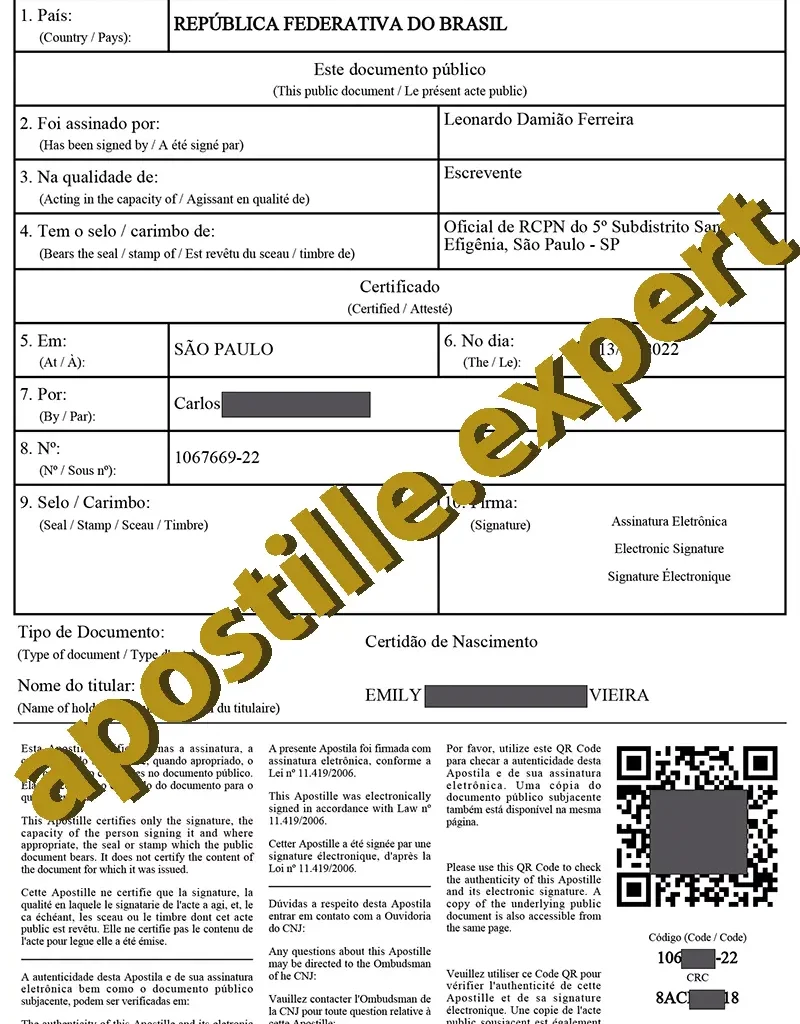
Text of the Brazilian Apostille
Language of the apostille — The Brazilian apostille contains information in Portuguese, English, and French. This ensures compliance with international standards and simplifies its use abroad.
Portuguese Language
BRASIL APOSTILLE
(Convenção da Haia de 5 de outubro de 1961)
- País:
REPÚBLICA FEDERATIVA DO BRASIL
Este documento público:
2. Foi assinado por: Leonardo Damião Ferreira
3. Na qualidade de: Escrevente
4. Tem o selo / carimbo de: Oficial de RCPN do 5º Subdistrito Santa Efigênia, São Paulo – SP
Certificado:
5. Em: SÃO PAULO
6. No dia: 13/06/2022
7. Por: Carlos ____________
8. Nº: 1067___-22
9. Selo / Carimbo:
10. Firma: Assinatura Eletrônica
Tipo de Documento: Certidão de Nascimento
Nome do titular: EMILY _____________ VIEIRA
Código: 106_______-22
CRC: 8ACB_______
A presente Apostila foi firmada com assinatura eletrônica, conforme a Lei nº 11.419/2006.
Dúvidas a respeito desta Apostila entrar em contato com a Ouvidoria do CNJ: ____________
Observação:
Esta Apostila certifica apenas a assinatura, a capacidade do signatário e, quando apropriado, o selo ou carimbo constantes no documento público. Ela não certifica o conteúdo do documento para o qual foi emitida.
A autenticidade desta Apostila e de sua assinatura eletrônica bem como o documento público subjacente, podem ser verificadas em:
https://apostil.org.br
Utilize este QR Code para verificar a autenticidade desta Apostila e de sua assinatura eletrônica. Uma cópia do documento público subjacente também está disponível na mesma página.
Translation of Brazilian Apostille into English
BRAZIL APOSTILLE
(Convention de La Haye of 5 October 1961)
- Country:
FEDERATIVE REPUBLIC OF BRAZIL
This public document:
2. Has been signed by: Leonardo Damião Ferreira
3. Acting in the capacity of: Clerk
4. Bears the seal/stamp of: Official of the Civil Registry Office of the 5th Subdistrict Santa Efigênia, São Paulo – SP
Certified:
5. At: SÃO PAULO
6. The: 13/06/2022
7. By: Carlos Eduardo Rodrigues
8. Nº: 1067_________-22
9. Seal/Stamp:
10. Signature: Electronic Signature
Type of Document: Birth Certificate
Name of holder: EMILY __________ VIEIRA
Code: 106___-22
CRC: 8ACB_____
This Apostille was electronically signed in accordance with Law nº 11.419/2006.
Any questions about this Apostille may be directed to the Ombudsman of the CNJ: ___
Note:
This Apostille certifies only the signature, the capacity of the person signing it, and where appropriate, the seal or stamp which the public document bears. It does not certify the content of the document for which it was issued.
The authenticity of this Apostille and its electronic signature, along with the underlying public document, may be verified at:
https://apostil.org.br
Please use this QR Code to check the authenticity of this Apostille and its electronic signature. A copy of the underlying public document is also accessible from the same page.
Translation of Brazilian Apostille into Russian
BRAZIL APOSTILLE
(Hague Convention of 5 October 1961)
- Country:
FEDERATIVE REPUBLIC OF BRAZIL
This public document:
2. Has been signed by: Leonardo Damião Ferreira
3. Acting in the capacity of: Clerk
4. Bears the seal/stamp of: Official of the Civil Registry Office of the 5th Subdistrict Santa Efigênia, São Paulo – SP
Certified by:
5. Place: SÃO PAULO
6. Date: 13/06/2022
7. By: Carlos Eduardo Rodrigues
8. Number: 1067___-22
9. Seal/Stamp:
10. Signature: Electronic signature
Document type: Birth certificate
Owner name: EMILY _______ VIEIRA
Code: 1067____-22
CRC: 8ACB___
This apostille was signed with an electronic signature in accordance with Law No. 11.419/2006.
For matters related to this apostille, contact the CNJ Ombudsman: _______
Note:
This apostille certifies only the signature, the capacity of the person who signed, and, if applicable, the seal or stamp affixed to the public document. It does not certify the content of the document for which it was issued.
The authenticity of this apostille and its electronic signature, as well as the underlying public document, can be verified at:
https://apostil.org.br
Please use this QR code to verify the authenticity of this apostille and its electronic signature. A copy of the underlying public document is also available on the same page.
Notes:
- The apostille only certifies the authenticity of the signature, the capacity of the signatory, and the presence of a seal or stamp. It does not certify the content of the document.
- The authenticity of the apostille and its electronic signature can be verified on the official website (apostil.org.br) using the QR code provided on the document.
Which documents are subject to apostille? — In Brazil, apostilles are issued for judicial documents, administrative acts, notarial acts, documents confirming entries in public registers, as well as educational documents (diplomas, certificates). Commercial and customs documents, as well as diplomatic and consular acts, are not subject to apostille.
Which documents are not subject to apostille? — Diplomatic and consular acts, customs documents, as well as documents related to commercial transactions are not subject to apostille.
Validity period of apostille — The validity period of an apostille is unlimited, but the applicability of the document depends on the validity period of the document itself. Before use, it is recommended to clarify the requirements of the receiving party.
Why is an apostille needed if documents from Brazil already have a seal and signature of an official?
An apostille is needed not to confirm the authenticity of documents from Brazil, but to confirm the signatures and seals of officials. The signatures of officials and seals of state bodies of Brazil, in turn, confirm the authenticity of documents. In state institutions of Brazil, such as ministries, departments, archives and civil registry offices, many officials work, whose signatures and seals change regularly. This makes verifying the authenticity of the document quite a difficult task, especially for foreign officials who need to accept these documents.
To simplify the verification process and avoid forgeries, a system was created to certify all signatures and seals by several authorized persons. This facilitates the work of foreign authorities, speeds up the process of reviewing documents abroad and reduces waiting time for applicants. The apostille system allows officials responsible for its issuance to verify the authenticity of signatures, seals, forms and the content of documents using an internal database.
Employees who have access to such databases of signatures and samples are also registered in a special register. This register includes a limited number of signatures that are transmitted to other partner states or verified using international instruments.
There are two main approaches to confirming the authenticity of documents. The first, most reliable, is legalization. The document is first signed and certified by the official who issued it, then by an employee of the ministry (usually the Ministry of Foreign Affairs), and the final signature is confirmed by the consulate of the country to which the document is provided. This process is based on verifying the chain of signatures and seals through three institutions.
The second method is based on simplification and greater trust between countries. This is an apostille — a special stamp established by the Hague Convention of 1961. An apostille allows eliminating the stage of legalization at the Ministry of Foreign Affairs and significantly speeds up the process of recognizing a document from one country in the territory of another.
Why get an apostille if Brazilian documents can be verified online?
Online document verification systems are a modern solution that allows for quickly confirming their authenticity. However, such systems are still under development and require significant improvements to ensure reliability and full functionality.
When governments and society are fully ready for the implementation of online verification systems, the need for an apostille may disappear. Nevertheless, until this technology becomes universally accessible and flawless, the apostille continues to play an important role.
Even with online verification, numerous officials will have access to such systems. This again raises the question of the relevance of signatures, frequent changes in officials, and the risk of abuse. In this context, the apostille acts as a universal tool that guarantees international recognition of the document’s authenticity regardless of existing local verification systems.
Can an apostille be obtained at the Brazilian consulate?
In accordance with the Hague Convention on Apostille, it is impossible to obtain an apostille stamp on Brazilian documents at the Brazilian consulate. This rule applies regardless of the country where the consulate is located, whether it is the USA, Germany, or any other country. An apostille can only be obtained from authorized authorities within the country, for example, notary services or relevant agencies in Brazil.
Is there an electronic apostille (E-apostille) in Brazil?
Yes, Brazil uses electronic apostille. It allows documents to be certified and verified online. The electronic apostille covers various types of documents, including birth certificates, marriage certificates, medical certificates, court orders, and educational documents intended for use abroad.
With the introduction of this system, Brazil joined the countries that provide digital verification of document authenticity. The National Electronic Apostille Register helps combat forgery and abuse. Any interested party can verify a document apostilled in Brazil through visual confirmation or by uploading a scanned copy of the document.
The integration of the electronic apostille into the national service system has significantly simplified the document certification process, reducing waiting times and effort for applicants.
How to verify an electronic apostille from Brazil?
Verification of apostille authenticity — The authenticity of a Brazilian apostille can be verified through the official electronic register at apostil.org.br. Verification uses a unique number and QR code, simplifying identification and protecting against forgery.
Electronic apostille — Brazil has implemented an electronic apostille system. This tool allows an apostille to be issued using an electronic signature, ensuring a fast and convenient verification process. The electronic apostille can be verified on the official website by entering the unique document code.
Verification of the electronic apostille is carried out using the unique apostille number and its date of issue. To do this, follow these steps:
- Gather the information:
- Unique apostille number (indicated in line No. 8 of the document).
- Date of apostille issuance (indicated in line No. 6).
- Go to the official website:
- Use the official website of the authorized body that provides apostille verification services. For example, for Brazil this could be apostil.org.br, and for other countries — their national portals.
- Enter the data:
- In the special form on the website, enter the apostille number and the date it was issued.
- Click the search button:
- After entering the data, click the search button.
- Check the result:
- A window will open where you can visually verify the apostille itself and the scan of the document to which it is attached.
This system allows you to quickly and reliably verify the authenticity of the apostille, as well as avoid fraud.
BUSINESS LIGA SRL · apostille.expert · +373 67 666 333