What is an Apostille?
An apostille is a wide-format impression or stamp used to certify the signature of the official who signed the document. This stamp is applied to documents of the new type for use abroad in Apostille countries. This stamp replaces the complex procedure of consular legalisation, which involves many more deadlines, confirming stamps or seals, and official signatures. An apostille is usually applied in black or blue ink on the reverse side of the document.
An apostille does not certify the authenticity of the document or its content. The authenticity and correctness of the document’s content are certified by the official’s signature. An apostille certifies the signature of the official who signed the document and their capacity (the official’s position and signing authority). In Japan and some other countries, it is a certification of the seal of a government authority.
Please note that an official’s signature certified by an Apostille does not guarantee the absence of errors in the document. It should also be kept in mind that in some countries, you need to draw the attention of the officials issuing the document to the fact that this document is intended for an apostille. This is because in some government authorities, there are officials whose signature is certified (approved) for documents submitted for an apostille.
In some cases, it is advisable to take precautions and request that the document be signed specifically by the head of the institution, for example, a school diploma by the school principal, not the head of studies. Furthermore, you should insist on having a genuine wet signature from the authorised person, not from a deputy or a signature of the director “made” by another person. You can find the Apostille Handbook in English at the link – https://assets.hcch.net/docs/ff5ad106-3573-495b-be94-7d66b7da7721.pdf).
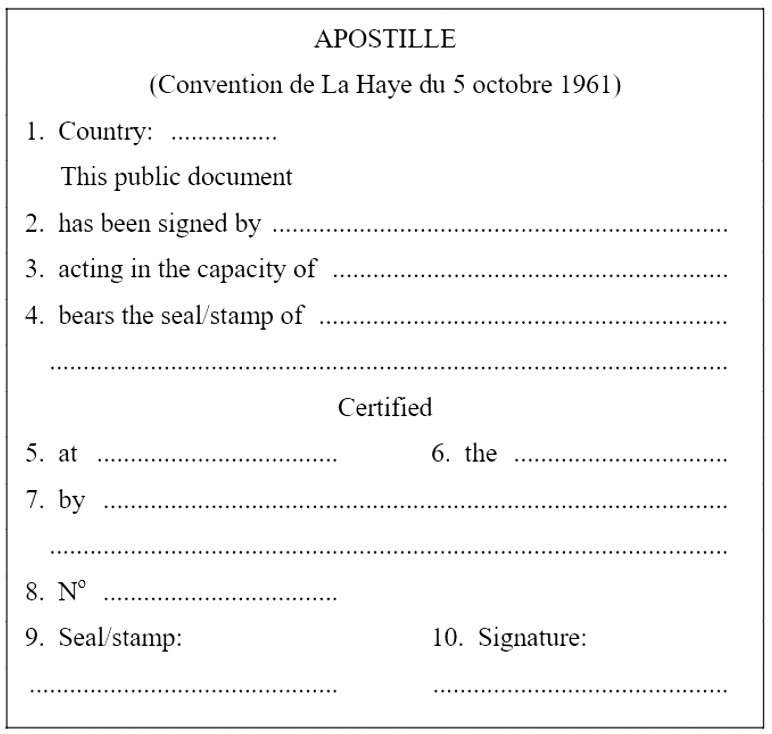
Appendix to the Hague Apostille Convention:
Sample Apostille Certificate – square with a side of at least 9 centimeters
What is an apostille for? Why is it needed?
Many countries around the world cannot verify the origin of a document or the signature on it because they do not have access to the personal data databases of other countries. Therefore, a procedure for additional verification of officials’ signatures was introduced. It is easier to maintain a database of officials’ signatures than the personal data of citizens from another country.
The apostille contains information about the official who signed it. This official is an authorized person with a certified signature. The people who sign the apostille have access to the database of registered signatures for documents from the country of origin.
Such an official will be responsible for confirming the signature of another official who signed the document. In this case, the document is considered most protected against forgery.
Which documents require an Apostille?
This stamp is required for documents issued by government authorities and educational institutions that you intend to submit abroad in a country that is a member of the Hague Convention.
These may include: a certificate of no criminal record, birth certificate, marriage certificate, divorce certificate, certificate of civil status, medical certificate, certificate confirming you own no real estate, diploma of secondary vocational or higher education, high school diploma, and other documents. Regarding legal entities, notarized translated copies of the company registration certificate and articles of association, as well as an original extract from the commercial register, are most commonly requested.
In CIS countries, including Armenia, Georgia, Kazakhstan, Moldova, Russia, Ukraine, and other countries, an apostille is only placed on documents issued by state authorities and notarized copies. The list of Apostille countries can be checked via this link >>>.
Can an apostille be placed on a notarized power of attorney, and how?
A power of attorney for representation of authority, signed by a notary, can be apostilled in the general procedure. The notary’s signature appears in the register for affixing an apostille.
And the following is also checked:
- the signature is checked against the registration of the document number and document name
- the authorized person affixes the Apostille stamp
- the receiving party, if necessary, verifies the Apostille
Can an apostille be placed on a consular power of attorney, and how?
A consular power of attorney, like any document issued at a consulate, is not subject to apostillisation. Such a document will only be valid for the country of the consulate and countries with which a relevant agreement on the avoidance of legalisation has been concluded.
For example, a power of attorney at the consulate of Ukraine will be valid for Ukraine, Moldova, Belarus, Kazakhstan (and other countries that have signed the Belarusian Convention), but an apostille cannot be placed on it for Apostille countries that have not signed any agreement on simplified document flow procedures with Ukraine.
Can an apostille be placed on a photocopy, a xerox copy of a document?
An apostille is not placed on simple copies of documents. In some countries, an apostille is also not placed on notarized copies of documents. In those countries where an apostille is placed on notarized copies, they generally have their own procedures and requirements.
Often, to apostille a notarized copy, they ask that you first obtain, or simultaneously obtain, an apostille on the original (duplicate) of the document.
Can an apostille be placed on a document translation?
An apostille can be placed on document translations, often on the condition that the original document to which the translation pertains has already been apostilled. In most countries, to apostille a notarized translation, they ask that you first obtain, or simultaneously obtain with the submitted translation, an apostille on the original (duplicate) of the document.
Be careful. Some countries, such as Italy, require different apostille procedures for document translations from different countries. For example, for documents from Moldova, an apostille is sufficient for Italy. For documents from Georgia, a translation by a consular translator is often required.
Furthermore, there are countries where translators for apostille purposes are special translators registered for such a procedure.
An apostille on a translation of notarized copies is also possible. Read the requirements for an apostille on notarized copies in the section above.
Can an apostille be obtained in another country?
Physically, an apostille can only be affixed in the country where the document was issued. This country must be a party to the Apostille Convention. Furthermore, an apostille is only placed on documents intended for countries that require it.
Procedure for confirming an Apostille by authorized persons:
The document is signed by an authorized person
- The signature is verified in the register by another authorized person (with the document number and document name registered in a special register).
- The authorized person affixes the Apostille stamp and, as a rule, also signs the Apostille (with the Apostille number and document name registered in a special register).
- The receiving party, if necessary, verifies the Apostille through the database of signatures of authorized persons of the document’s country of origin.
Which countries have not signed the Apostille Convention?
It is easier to check the list of Apostille countries (Hague Convention of 1961) to see if your country is on this list or not. You can check the list of Apostille countries via this link >>>. However, we list the most frequently requested countries that have not signed the Apostille Convention and require document legalization: China (excluding Hong Kong and Macau), Libya, the United Arab Emirates, Kuwait, Iran, Iraq, Egypt, Palestine, Qatar, Canada, Costa Rica (data as of October 5, 2022).
There are quite a few countries that have signed the Apostille, but their Apostille is not recognized by some countries partially or fully. Such countries apply the procedure of consular legalization to each other. You can read more about these countries via this link >>>.
Can an Apostille be obtained at a consulate?
Documents issued (produced) by consulates cannot be apostilled (according to the Apostille Convention). This negates the purpose of granting consulates the authority to affix an Apostille. Only in the consulates of some countries can you request an Apostille. However, in this case, the apostille will not be affixed by consulate staff.
The document will have to be sent via consular mail to the relevant authorities of the country that issued it. Then these documents with the apostille will need to be sent back to the consulate via consular mail. This takes a considerable amount of time and does not guarantee a successful outcome. There may be errors and shortcomings. Most consulates do not handle the apostille issue. The consulate is not authorized to apostille documents. In the case of recognition of documents in another country – consulates only participate in the process of consular legalisation.
Can I get an Apostille at the embassy?
The consulate and the embassy are two different structures of one state’s international mission. The consulate is responsible for receiving citizens of its country on the territory of the country where it is located. The consulate handles citizen reception regarding documents: requesting documents from the country (passports, certificates and statements, civil status acts, and others). But, as mentioned earlier, such documents cannot be apostilled. Often, consulates responsible for citizens of one country are located on the territory of another country. For example, the consulate of the United Arab Emirates, which handles Arab documents for Moldova (or Moldovan documents for the United Arab Emirates), is located in Romania. The embassy does not handle documents of its country’s citizens.
The embassy is a country’s representation to another country and on its territory. The embassy handles interstate and intergovernmental matters. Therefore, embassies do not issue documents to their country’s citizens and do not apostille them. It often happens that a particular country does not have an embassy on the territory of another country but has a consulate. Or vice versa.
BUSINESS LIGA SRL · apostille.expert · +373 67 666 333