Apostille Poland
What is a Polish apostille?
The Polish apostille – is a stamp whose form, content, and purpose are defined by the Apostille Convention of 1961. The Polish apostille contains information in both English and the official Polish language.
Poland acceded to the Hague Apostille Convention on November 19, 2004. The apostille became effective from August 14, 2005.
By decision of the Polish authorities, the Convention does not apply to documents issued by Russian authorities in Crimea and Sevastopol, as well as documents issued by the authorities of the self-proclaimed Donetsk and Luhansk republics.
The apostille in Poland is affixed in two languages: Polish and English, regardless of whether the document has been translated into English, another language, or not.
What does the Polish apostille look like?
Photo of the Polish apostille:
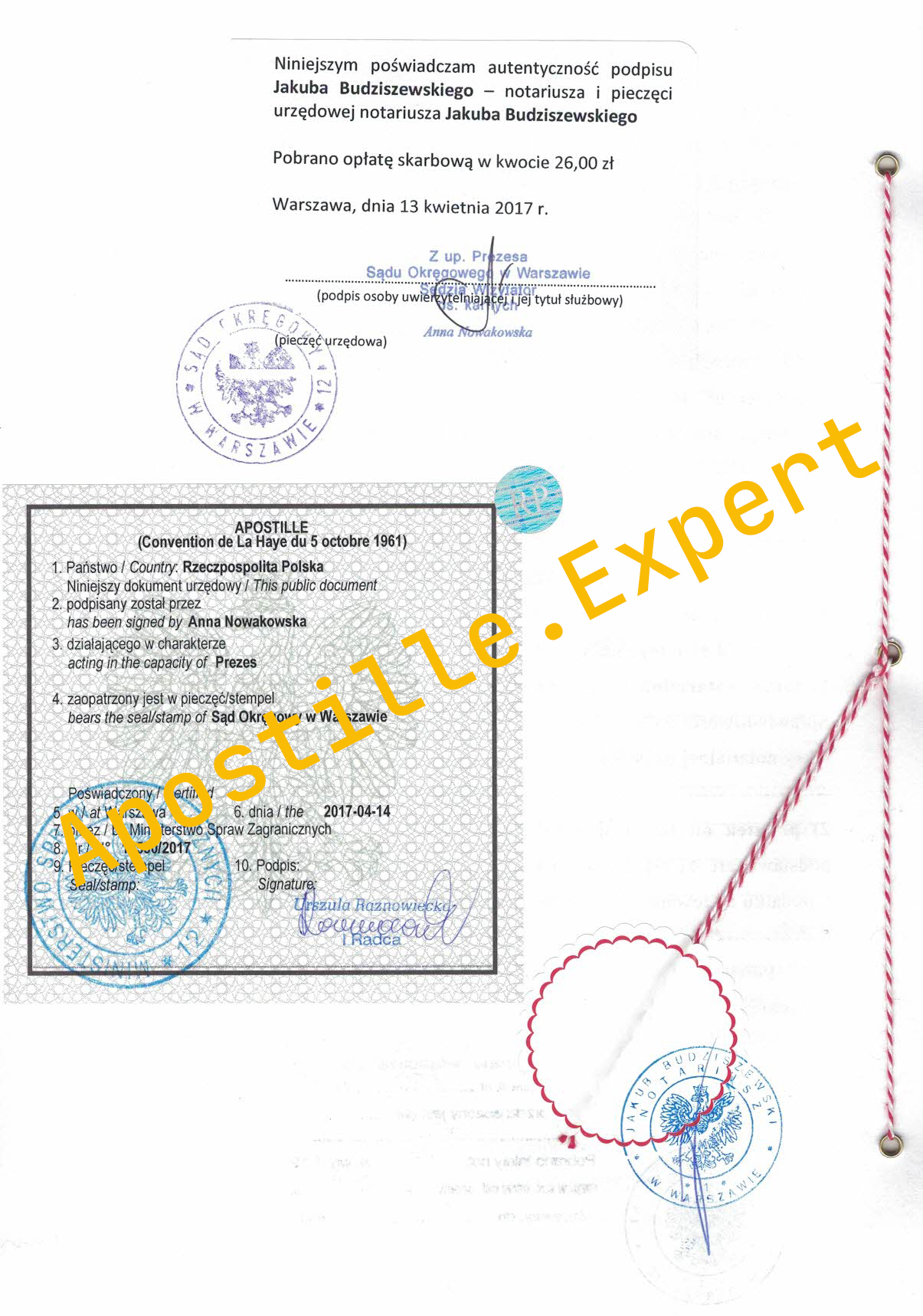
Text of the Polish apostille
Polish language
(Convention de La Haye du 5 octobre 1961)
1. Państwo / Country: Rzeczpospolita Polska
Niniejszy dokument urzędowy / This public document
2. Podpisany został przez /has been signed by: ___________________________
3. Działającego w charakterze / acting in the capacity of: ________________
4. Zaopatrzony jest w pieczęć / bears the seal/stamp of ________________
Sąd Okręgowy w Warszawie Poświadczony / Certified
5. w / at: __________________
6. dnia / the __________________
7. przez / by: Ministerstwo Spraw Zagranicznych
8. Nr / № ____________________
9. Piekzęć / Stempel /Seal/stamp
10. Podpis / signature
Translation into Russian
(Hague Convention of October 5, 1961)
1. Country: Poland
This public document
2. Signed by: __________________ (by whom, surname first name)
3. Acting in the capacity of: _________________ (position)
4. Seal/stamp:
Certified with seal/stamp
5. Place: _______________ (city)
6. Date: __________________
7. Organization: ______________________
(note: BUSINESS LIGA SRL: Ministry of Foreign Affairs of Poland)
8. No. ____________________
9. Seal / stamp
(note: BUSINESS LIGA SRL: Seal of the authority authorized to certify apostilles)
Why is an apostille needed if documents from Poland have the seal and signature of an official?
Regulation (EU) 2016/1191 of the European Parliament states that an apostille is not required for documents from Poland intended for other EU countries. However, for other countries not in the EU but party to the Hague Convention, an apostille is required.
There are many officials working in Polish ministries, departments, state authorities, archives, and civil registry offices.
There are many signatures, and they also change. To verify the authenticity and truthfulness of a document and to avoid forgeries, it is necessary to check whether the official’s signature matches the specimen signature on file and whether it was that official who signed the document.
On the scale of such a volume of documents and such a number of officials, this is very difficult to do. It is especially difficult, even repeatedly so, for those officials who receive your documents abroad.
Therefore, a system was created to confirm all signatures and seals by several parties – to make the work of foreign officials easier. This also reduces the time for reviewing documents abroad, as well as the waiting time for applicants. In such a system, local officials responsible for Apostilles can more easily verify signatures, seals, and the documents themselves (their forms and content).
Employees who have access to the internal database of signatures, seals, and document specimens also enter a special registry with their own signatures. However, this registry is limited to a dozen signatures, the specimens of which are transmitted to other partner countries or can be easily verified by them through other means.
There are two procedures for such confirmation. The first procedure – the most reliable – is legalization of documents. When documents are signed by the issuing official, then the document is certified by a ministry employee (usually the Ministry of Foreign Affairs), then the last signature is verified and certified by the consulate of the country where the documents need to be submitted. Verification is carried out on the basis of an up-to-date database (list) of signatures – through a chain of three departments (institutions, state bodies).
The second procedure is based on greater trust and bypasses one department, usually the Ministry of Foreign Affairs. In this case, we are talking about an apostille. An apostille – a special stamp of a prescribed form – significantly simplifies the procedure for recognizing documents of one state on the territory of another.
Is it possible to get an apostille at the Polish consulate?
According to the Hague Apostille Convention, the apostille on Polish documents cannot be obtained at the Polish consulate. And this does not depend on the country where the consulate is located, be it Moldova, Germany, Ukraine, Italy, and so on.
Where can one get (obtain) an apostille in Poland?
1. Ministry of Foreign Affairs (Ministerstwo Spraw Zagranicznych)
Documents that can be apostilled:
Certificates and statements, including civil status documents: birth certificate, marriage certificate, divorce certificate, death certificate, name change certificate, certificate of no criminal record, civil status certificate (that a person is not married), as well as translations of documents certified by a notary and translator.
2. National Agency for Academic Exchange (Narodowa Agencja Wymiany Akademickiej; NAWA)
Documents that can be apostilled:
diplomas of education with supplements, copies of diplomas, certificates of diplomas and certificates, duplicates of diplomas and certificates of education, educational certificates, doctoral and postdoctoral diplomas, as well as their duplicates and copies.
3. Ministry of Culture, National Heritage and Sport (Ministerstwo Kultury, Dziedzictwa Narodowego i Sportu)
Documents that can be apostilled:
certificates, diplomas, certificates from art schools, documents issued by schools, except those mentioned above.
4. Ministry of Education and Science (Ministerstwo Edukacji i Nauki)
Documents that can be apostilled:
certificates from schools and vocational schools, as well as from schools, vocational-technical schools, and school counseling centers at diplomatic missions, consular offices, and military representations of the Republic of Poland.
5. School Superintendents (kurator oświaty)
Documents that can be apostilled:
certificates of promotion and school leaving certificates,
other documents issued by schools, supplementary education institutions, and practical education institutions, except those mentioned above, intended for legal transactions with foreign states.
6. Directors of Regional Examination Commissions (Okręgowa Komisja Egzaminacyjna)
Documents that can be apostilled:
certificates of primary and secondary education at the level of external exams, secondary education certificates, supplements to secondary education certificates, certificates confirming professional qualifications, diplomas and certificates issued by regional examination commissions.
Is there an electronic apostille in Poland – E-apostille?
The electronic apostille allows certifying birth and marriage certificates, medical documents, court rulings, and other documents for use abroad.
Using the electronic apostille register, any interested person can visually check the apostille of a document and the scanned document.
However, Poland does not yet have an online apostille verification system.
Who issues the apostille in Poland — by document type (current as of 2026)
In Poland, the apostille is issued by the Ministry of Foreign Affairs (MSZ), but two categories of documents have their own procedure, and almost all require preliminary certification — without it, the MSZ will refuse.
| Document | Procedure |
|---|---|
| Civil registry certificates (USC), departmental certificates, extracts from KRS, translations by a sworn translator (tłumacz przysięgły) | apostille is placed by MSZ — Dział Legalizacji |
| Notarial documents (deeds, powers of attorney, certified copies) | first certification in the district court (sąd okręgowy) at the notary’s location, then apostille from MSZ |
| Court documents | first certification by the president of the district court, then apostille from MSZ |
| University diplomas and documents on the progress/completion of studies | apostille is issued by NAWA — National Agency for Academic Exchange (not MSZ) |
| School certificates (świadectwa) | preliminary certification by the kuratorium oświaty (education authority) or examination board, then apostille from MSZ |
Deadlines, costs, and submission addresses in Poland
| Parameter | Value |
|---|---|
| State fee for apostille | 60 zł for each certified document |
| Legalization fee (for non-Convention countries) | 26 zł |
| In-person submission | MSZ, Dział Legalizacji, ul. Krucza 38/42, Warsaw — by appointment (e-Konsulat); with a complete set, the apostille is usually placed during the same visit |
| Submission by mail | al. Szucha 23, 00-580 Warsaw — requests are processed up to 30 days from the date of receipt by MSZ |
| Electronic apostille | not provided for a wide range of documents — apostille is issued on paper |
Additional costs: obtaining the documents themselves, preliminary certifications (court, kuratorium), sworn translation, and delivery. The difference between ‘on the same visit’ and ‘up to 30 days’ — that is precisely why we submit documents in person through a representative in Warsaw, rather than by mail.
Is an apostille required for Polish documents for EU countries?
Poland is an EU country, therefore according to Regulation (EU) 2016/1191 documents on birth, death, marriage, marital status, place of residence, and no criminal record are accepted in other EU countries without an apostille (if necessary, with a multilingual standard form). An apostille is mandatory when a Polish document goes outside the EU: Moldova, Ukraine, United Kingdom, Turkey, USA, China, and other Convention countries. For countries outside the Convention — consular legalization.
Frequently asked questions about the apostille of Poland
How much does an apostille cost in Poland?
State fee — 60 zł per document. The final cost depends on whether preliminary certifications (court, kuratorium), obtaining the document, sworn translation, and delivery are needed.
Why is a diploma not apostilled by MSZ?
Because according to Polish regulations, the apostille on documents related to the course or completion of studies at a university is issued by NAWA. Submitting such a diploma to MSZ will lead to rejection and loss of time.
Is the translation of a sworn translator apostilled?
Yes — MSZ places an apostille on translations made by a Polish tłumacz przysięgły. This is convenient when the receiving party requires an apostille specifically on the translation.
How long is a Polish apostille valid?
Indefinitely — the Convention does not set a term. The limitation on “freshness” applies to the document (certificate, extract from KRS), not to the apostille.
Order an apostille on Polish documents
USC certificates, criminal record certificates (KRK), diplomas (via NAWA), KRS extracts, notarial and court documents — we go through all stages of certification and obtain an apostille in Warsaw without your travel, with sworn translation and delivery.
Phone / WhatsApp / Viber / Telegram: +373 67 666 333 · write to WhatsApp · Order apostille · contact form · contacts
Sources (official)
gov.pl — MSZ, Apostille (fee 60 zł, NAWA, court certifications, addresses and deadlines) · HCCH — table of participants (accession 19.11.2004, entry into force for Poland — 14.08.2005). Data verified in July 2026.
Apostille in other European countries
Apostille United Kingdom · Apostille Ireland · Apostille Portugal · Apostille France · Apostille Spain · Apostille Czech Republic · Apostille Belgium · Apostille Germany · Apostille Croatia · Apostille Slovakia · Apostille Serbia
BUSINESS LIGA SRL · apostille.expert · +373 67 666 333 — material verified and published in full.